No single source of truth
Six systems. Six answers. No agreed number.
Profit analytics SaaS for UK Shopify brands
Neo Analytica is a founder-led SaaS product that connects Shopify, your ad platforms, returns, product costs and finance data into one profit view that matches your business. Flat monthly pricing from £129, never tied to sales or ad spend.
Free audit · No pitch deck · You speak to me, not a sales team · Honest “not a fit” answers.
Sound familiar?
Your tools report the data. None of them reconcile it.
01 / 06 recurring failure modes
Six systems. Six answers. No agreed number.
Copy, paste, fix, repeat—every reporting cycle.
The report lands after the decision window has moved.
Revenue rises while contribution quietly disappears.
More subscriptions. More logins. No clearer answer.
APIs drift; silent failures become another team workload.
Drag, swipe or use the arrows to explore
Public excerpt · r/GoogleAnalytics“GA4's purchase count and the real order count in the backend never match.”
Public excerpt · r/startup“Six hours every single week. I dread Sundays now.”
Public excerpt · r/ecommerce“most people brute force with spreadsheets until they hate themselves…”
Public excerpt · r/ecommerce“By the time the report was ready, the data was already stale.”
Public excerpt · r/startup“the silent-failure thing with Zapier is very common.”
More reports cannot fix numbers built on different definitions.
Neo Analytica aligns the sources, definitions and numbers your team acts on.
Public Reddit excerpts are shown as market context—not Neo testimonials.
A clear process, start to finish
I review your sources, show where and why the numbers disagree, and recommend a plan—or tell you Neo is not a fit. You receive a written summary either way.
I connect the agreed sources, tie orders, ad spend, returns, product costs and payouts to the same period, and document the definitions behind revenue, CAC and margin.
Your Neo workspace refreshes automatically, with alerts if a source stops syncing.
Growth and Scale include a monthly margin review with me, so the numbers stay trusted as your stack changes.
The clarity check: before onboarding, we agree in writing how the numbers will be tested. If the agreed checks do not pass, I keep working at no extra professional fee until they do.
What you get
Orders, revenue, spend, returns, product costs and finance for the same period, with the unattributed share shown openly.
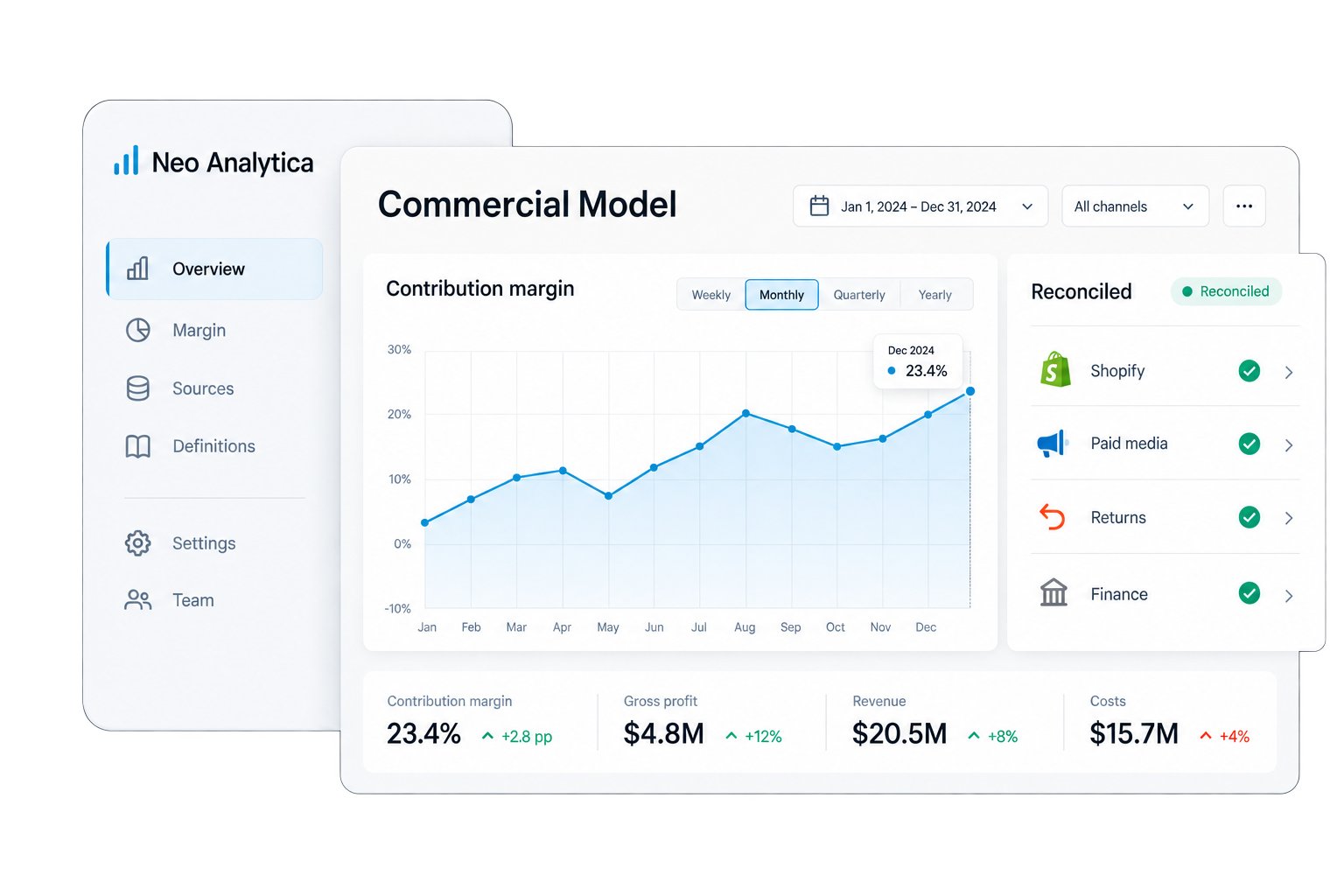
A margin bridge from gross revenue to contribution after paid media.
On Growth and Scale, payouts, orders and finance are reconciled so marketing and finance use the same figure.
Revenue, CAC, LTV and margin written down once, so meetings stop being arguments about whose number is right.
No weekly CSV ritual—and you hear about a failed sync before it reaches a report.
Use the Neo workspace, Sheets or CSV, with additional reporting and warehouse options scoped to your plan.
Interactive reconciliation demo
Switch between platform-reported revenue, verified orders and contribution after returns, fees, product cost, fulfilment and paid media.
Platform claims
£343,900Each platform uses its own attribution rules, so the claims overlap.Works across your stack
Neo can scope sources with a usable export or API. Exact connector coverage, refresh frequency and historical depth are confirmed in the free audit before you commit.
Includes Shopify Plus and Amazon Seller Central scope.
 Shopify
 Amazon
 Etsy
Etsy TikTok Shop
 Meta Ads
 Google AdsTikTok Ads
 Amazon Ads
 GA4Shopify Payments
 PayPal
 Stripe
Compatible ERP and 3PL exports or APIs can be scoped in the audit.
 Xero
Xero QuickBooks
All four operational layers resolve into
 Neo reconciliation layerOne definition for revenue, cost and profitNeo workspace
 Google Sheets
Work in Neo or take the agreed numbers back into your existing workflow.
Meet the founder
Neo is an early-stage product, built and supported by Amani Mulira. There is no borrowed customer credibility here: you can review Amani’s professional background directly on LinkedIn.
Explore the product demo →The free data audit and interactive product demo show how Neo calculates profit.
Every step, what I need from you, and how we confirm the numbers tie out are written down up front.
The work reconciles commercial reporting to payouts and finance—not only to platform reports.
You work with me directly, with a monthly margin review on Growth and Scale.
No tracking pixel and no attribution model to defend. Neo can referee between Meta, Google, GA4, Klaviyo and Shopify.
Your price does not change because you had a good quarter.
Pricing
Monthly, cancel any time—or pay annually and get two months free. Prices exclude VAT.
Starter
£1,290/year · two months free
One Shopify store with a straightforward commercial stack
OnboardingFree self-serve setup plus a 45-minute setup call
Growth
£3,490/year · two months free
Multichannel brands that need marketing to reconcile with finance
Onboarding£495 onboarding, waived on annual
Scale
£7,490/year · two months free
Multi-store or multi-entity teams with more complex reporting
Onboarding£1,495 four-week build, waived on annual
Just need a basic profit tracker? A lightweight app may be all you need. Neo is the SaaS product for when marketing numbers have to reconcile with the rest of the business, across channels, with founder-led support when you need it.
FAQ
If the honest answer is that Neo is not a fit, the free audit will say so.
That is a fair question. I cannot show you a wall of customer logos yet. You can inspect the method in the free audit, interactive product demo and free toolkit, review my professional background on LinkedIn, and cancel a monthly plan at any time.
A simple profit tracker may be all you need. Neo is for when marketing numbers need to reconcile with payouts and finance across channels, with definitions your team agrees and a real person checking them.
Attribution platforms focus on tracking and assigning credit. Neo focuses on reconciled profit, works alongside the attribution you already use, and charges a flat monthly price.
Yes. There are no sales, order or ad-spend bands. Your price changes only if you choose a different tier or agree additional custom work.
They measure different things. Ad platforms use their own attribution windows, GA4 can miss consent-blocked orders, and Shopify records every paid order. Neo does not force them to match; it reconciles at order level and shows the unattributed share openly.
Usually not. Neo works alongside your stack. Once the numbers are reconciled, you may find some subscriptions are no longer needed. If so, I will tell you.
That is normal. The free audit and onboarding make the gaps explicit and separate what can be fixed now from what needs a process change.
You receive an alert and I investigate it. Growth and Scale also include a monthly review to catch slow drift.
Access is limited to what is needed, data minimisation is the default, and handling responsibilities are agreed before work starts. A DPA is available on request.
Brands that only need a basic profit tracker, single-channel stores with simple costs, and teams that only want a static reporting view. I will tell you if that is you.
Start with the disagreement
Tell me in a free data audit. You will get a clear view of where the numbers disagree, even if we never work together.